
Ask anyone who has handled large losses for a while, and they’ll tell you the same thing. Property damage used to be the headline figure. Business interruption came second, often smaller and sometimes it felt like an afterthought.
That’s no longer the case. Recent analysis from Allianz Commercial puts the average business interruption claim above €850,000, about 70% higher than the average property damage claim. BI values have been climbing by more than 30% a year over the last two years, pushed up by longer recoveries, supply chain problems, inflation and the rising cost of mitigation. And this isn’t a handful of unusual cases: the study looked at almost 7,900 claims between 2021 and 2025.
If you want to see where this is heading, look at data centres.
A lot of revenue in one place
A hyperscale campus puts a huge amount of earning capacity on a single site. Unsurprisingly, BI is now the biggest driver of severity on data centre losses. It doesn’t take much: a fire in an electrical room or a cooling failure can stop revenue across thousands of racks.
Then comes the wait for parts. Switchgear can take up to 80 weeks to arrive, transformers up to 50 and generator step-up transformers passed 160 weeks earlier this year. The equipment that fails is often exactly what the whole AI build-out is queuing for. A repair that might have taken four months a few years ago can now stretch well past a year.
The technology is also changing what goes wrong. AI halls increasingly use liquid cooling, and that brings a new set of problems: coolant leaks, manifold failures, corrosion and contamination in the loop. A few minutes without cooling can cause a thermal event along an entire row. At that point it’s rarely one server that’s damaged. It can be hundreds of Graphics Processing Unit’s (GPUs) failing at once, all waiting in the same queue for replacements. The physical damage and the interruption come from the same event and run into the same shortages, so it makes little sense to handle them separately.
Delay in start-up: when would it really have opened?
On a project still under construction, the two most important questions are how long the repair took and where the project actually stood on the day of the loss.
DSU covers the delay against the date the project would have started operating if the damage hadn’t happened. That isn’t always the date in the original programme. If the project was already eight weeks behind, those eight weeks aren’t part of the claim. Working that out means looking closely at real progress before the loss, rather than trusting the latest programme update.
Most of the arguments happen around concurrent delay. A substation fire might coincide with late chillers, a design change and a grid connection that was never going to be ready on time anyway. Only the delay caused by insured damage is recoverable, and delays from defects or other uninsured events stay outside the claim. Separating insured, uninsured and excluded causes properly is specialist work and delay experts should be involved from the start.
Lost revenue starts with the contracts
Data centre income is contractual, so the claim depends on the paperwork: budgets, pricing, ramp-up assumptions and, most importantly, termination rights.
Colocation and hyperscale agreements usually include Service Level Agreements (SLAs) on power availability, cooling, humidity and security. Miss them and service credits kick in. Miss them badly and the tenant may be able to walk away. A long outage after a major event can also allow termination under force majeure. Under the loss of profit cover, once a tenant leaves, the loss doesn’t stop when the building is fixed. It carries on until someone else takes the space.
This is where the wording really matters. A UK-style Loss of Profit policy, with an indemnity period that runs until trading recovers, can pick up those lost tenants and the time it takes to re-let. A US-style Gross Earnings form usually stops at the end of the restoration period, unless an extended period of indemnity was bought. On a data centre with a long tail of lost contracts, the gap between the two can be huge.
When the damage happens somewhere else
Contingent business interruption is getting a lot of attention, and for good reason. Lean, concentrated supply chains mean a fire at a supplier or a failure at a cloud host can hit a business as hard as damage at its own site. Data centres sit on both sides of this. They depend on the grid, fibre routes and equipment suppliers, and they are a critical supplier to everyone who runs on them. In June, a fire at a third-party data centre disrupted Google Cloud customers in India. In one leading insurer’s portfolio, CBI’s share of large cyber claims more than doubled in a year, from 6% to 15%.
These claims are hard to investigate and manage. The damage is at a site the insured doesn’t control and the indemnity period depends on someone else’s recovery. Many CBI extensions also still require physical damage at the supplier, apply only to named suppliers, or carry waiting periods longer than most outages last.
What is actually insured?
The usual basis of cover comprises either full Revenues, Gross Profit, Gross Earnings, fixed costs only, debt servicing or increased cost of working. On project finance DSU, the insured interest is often debt service rather than gross profit, because that’s what the lenders want protected.
Then there’s the question of whether the sum insured is sufficient. A Gross Profit sum insured with a 24-month indemnity period should reflect two years of gross profit but considering the loss could happen on the last day of the policy period, ie. a very forward-looking budgeting data is required with inflation and valuations moving quickly, declared values fall behind faster than people expect. If average applies, the insured ends up sharing every pound of the loss, and that’s never an easy conversation.
Mitigation is where the real savings are
The best result on a BI claim is a smaller claim and getting involved early is what makes that possible.
On construction losses, it helps to look at property damage and DSU side by side. Flying a transformer in, or paying for an earlier factory slot, might add to the PD claim but take far more off the DSU claim. Running those numbers early lets insurers make that call deliberately instead of finding out afterwards.
Once a data centre is impacted, moving the work elsewhere is often the best option. Shifting workloads to another of the insured’s sites, or to third-party capacity, keeps customers on board and cuts the loss. Revenue recovered this way counts against the claim and the cost of doing it is normally covered as increased cost of working.
There’s a limit, though. Under most wordings, increased cost of working is only recoverable up to the amount of loss it saves. And if the benefit runs past the maximum indemnity period, say by keeping a tenant whose contract runs for years, insurers will usually only pay the part of the cost that relates to savings within the indemnity period. Agreeing that split before the money is spent saves a lot of argument later.
The small print still counts
Contractual penalties and service credits are usually excluded unless they’ve been specifically insured. DSU programmes often have daily or monthly limits and time deductibles. Coinsurance and average come into play when the sum insured falls short. None of this is new, but on losses this size, each of these points can move the settlement by millions.
How Advanta handles these claims
Advanta’s data centre practice is built around how these losses actually play out. That starts with knowing the technology, including cooling systems, on-site power generation and grid connectivity, and how each of them fails. It also means accepting that no single discipline has all the answers on a claim like this.
So on a data centre loss, construction, power, engineering, project management and controls, DSU and business interruption specialists work as one team from the first site visit. The engineers looking at cause and reinstatement sit alongside the people measuring delay and lost revenue, because each affects the other. Insurers and brokers have one point of contact, overseeing the claim from first notification through to settlement.
The same team covers the whole life of the asset, from construction and commissioning into operation, and works before a loss as well as after one. Pre-loss risk surveys draw directly on what the claims reveal: where the single points of failure are, how long replacement would really take and whether the sums insured and indemnity periods match that reality.
Most of what decides a BI claim happens in the first few weeks. There’s plenty that insurers, brokers and insureds can do before then. Check BI and DSU sums insured against today’s lead times. Make sure indemnity periods allow enough time to re-let lost capacity. Understand the contracts and SLAs before anything goes wrong. And when a loss does happen, get the right specialists in early, and get them working together. Cause, delay and quantum all depend on each other on these claims.
The physical damage may still make the news. More and more, though, it’s the interruption that decides how big the claim ends up being.
David Ward, Director, Advanta Global Services
Photos and text source: Advanta Global Services
*****
Breakfast & Technical Forum Miami Reinsurance Week 2027
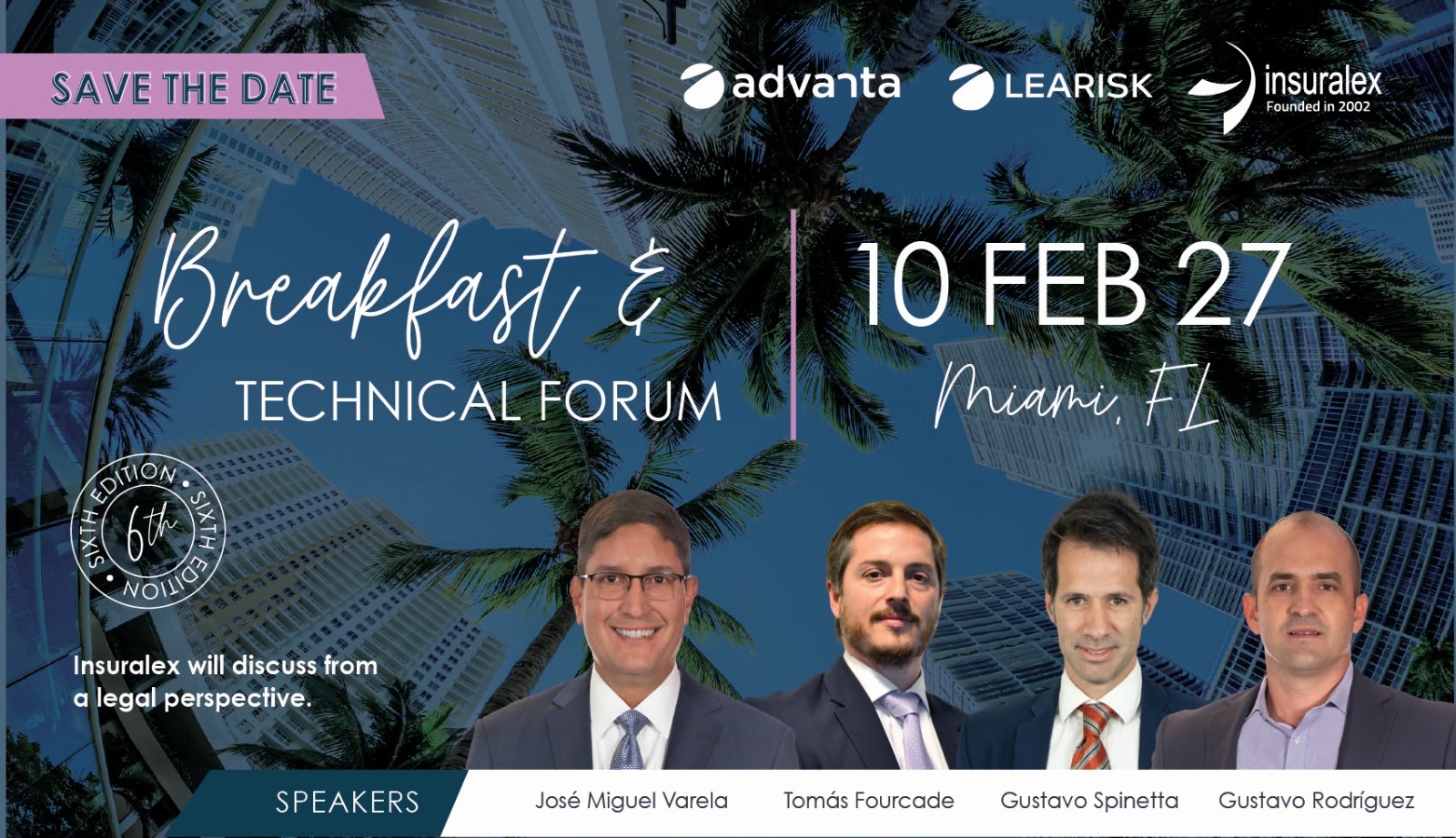
Save the date! 10 February Miami Reinsurance Week 2027
Advanta, Learisk and Insuralex are pleased to announce the date of the Breakfast & Technical Forum, which will take place in Miami on 10 February 2027.
Now in its sixth edition, this important Miami forum continues to build on the strong success and industry recognition achieved in previous years.
In this year’s event, experts will explore the challenges and opportunities arising from a world with rapidly growing energy demands, focusing on the expansion of data center infrastructure, energy storage solutions, extended equipment lead times, and the accelerating adoption of electromobility.
Insuralex attorneys from Latin America will share their experience and know-how on the hot topics from a legal point of view.
It is a unique opportunity to hear first-hand from professionals with a high level of technical expertise and extensive market knowledge.
We invite you to save the date and join us in Miami! Save the date!