
This report looks at how AI is changing the risk and claims landscape, why losses may lag behind adoption, and highlights what businesses can do to better understand, manage and transfer AI-related risks.
Artificial intelligence (AI) is transforming the global economy at unprecedented speed, moving rapidly from emerging technology to a boardroom priority. Adoption is accelerating and AI is already embedded in many business processes – from production planning to autonomous systems to pricing models.
In just one year, AI has also surged from #10 to #2 in the Allianz Risk Barometer – the largest year-on-year rise of any category in the annual business survey. This dramatic shift reflects growing awareness among businesses and insurers that AI is not simply a technology issue but a fundamental business, governance, and leadership challenge.
Yet despite this heightened concern, confirmed AI‑related insurance losses remain relatively low. Based on current claims data, AI would not rank even in the top 20 loss drivers. However, AI losses are frequently underreported, difficult to quantify or attribute, or are recorded under traditional categories such as cyber, directors’ and officers’ (D&O) liability, or product liability insurance. The true risk exposure is substantial and growing fast. A sharp increase in losses may be anticipated.
AI-related incidents and litigation have risen in recent years with corporates being sued for a wide range of AI-related issues, including intellectual property and copyright infringement, data privacy breaches, hallucinations (false information), discrimination, bias and environmental issues, as well as the overstatement or misrepresentation of companies’ strategic capabilities.
Databases tracking AI incidents and lawsuits show they are significantly increasing every year. For example, the number of incidents rose from 179 in 2023 to 307 in 2024 and 453 in 2025, according to the MIT AI Risk Initiative (as of October 7, 2026) and this trajectory shows no sign of slowing.
At the same time, AI-related securities class action lawsuits in the US have followed a similar pattern, with 22 filings in 2026 alone (as of the end of August), compared to 16 in all of 2025.
Allianz Commercial is already tracking AI-related insurance claims with substantial values in the millions of euros. Examples of cases include accidents caused by alleged defective AI safety systems in vehicles and shareholder-filed securities litigation alleging misleading AI-related disclosures and omissions by company executives. Such cases could easily result in total insurance industry losses in the region of US$100mn each.
AI risk operates on several levels. One level lies within the technology itself. AI systems rarely express uncertainty. At the same time, they are highly sensitive to prompts and can exhibit confirmation bias, meaning small nudges can significantly influence outcomes. This can cause issues in negotiations, assessments or decision-support scenarios.
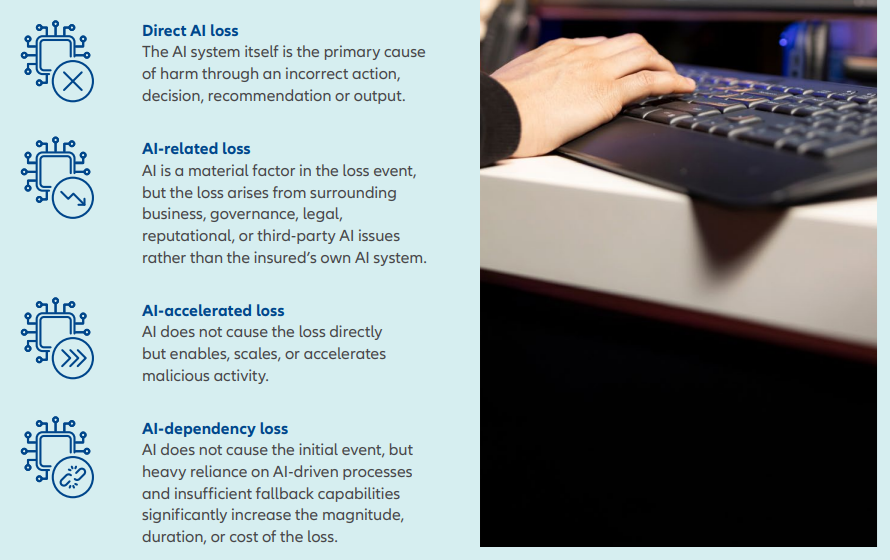
A second level arises from how AI is used in organizations. Experience is still limited across many functions. At the same time, competitive pressure to deploy AI quickly is enormous. Even when companies act responsibly, the probabilistic nature of AI means that mistakes could still happen. A further level consists of indirect risks. In many cases, AI is not the direct cause of damage, but a force multiplier. For risk management purposes, it is therefore crucial to interpret AI-related harm broadly.
Learn more: Artificial intelligence: loss scenarios and claims developments
Source: Allianz Commercial